> ## Documentation Index
> Fetch the complete documentation index at: https://cyborg-encryption-copy.mintlify.site/llms.txt
> Use this file to discover all available pages before exploring further.
# Security Overview
CyborgDB is designed to address one of the most urgent and overlooked risks in enterprise AI: **centralized AI data becoming a single, high-value breach target**.
As enterprises adopt AI applications—especially those using Retrieval-Augmented Generation (RAG) and other data-intensive approaches—they centralize data from multiple systems (Finance, HR, CRM, Email, Documents) into a single vector database. While this boosts AI performance, it also creates a **single point of failure** with unprecedented blast radius potential.
A well-scoped threat model is essential to evaluate whether CyborgDB's security properties align with your risk profile. This page should be read alongside the detailed [Encryption](./encryption) and [Threat Model](./threat-model) sections.
## 1. The Centralized Intelligence Risk
Before AI adoption, sensitive enterprise data was naturally segmented across multiple systems, each with independent security perimeters. AI fundamentally changes this landscape by requiring data centralization for optimal performance.
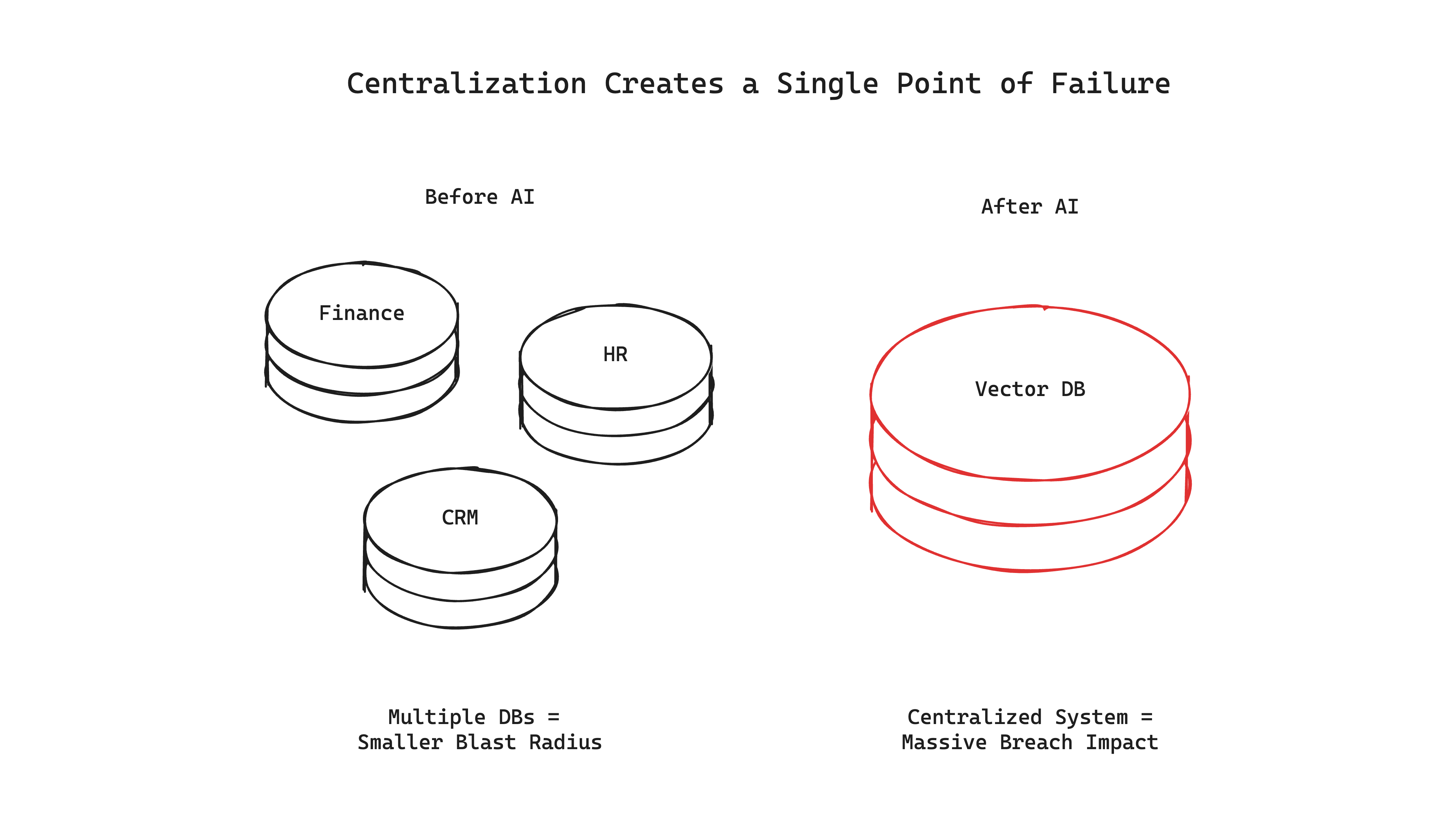 This architectural shift creates a **concentration risk**: instead of requiring separate breaches of multiple systems, attackers need only compromise one vector database to access intelligence from across the entire organization.
### Vector Database Vulnerability Profile
Standard vector databases exacerbate this risk through fundamental design choices:
Embeddings stored without encryption, immediately exploitable upon access
Each vector encodes rich semantic content from source documents
Vector format specifically vulnerable to machine learning exploitation
## 2. Attack Mechanics
When attackers compromise a traditional vector database, they can execute a systematic intelligence extraction process:
```mermaid theme={null}
graph LR
A(Database Access) --> B(Plaintext Extraction)
B --> C(Inversion Models)
C --> D(Content Reconstruction)
D --> E(Cross-System Correlation)
E --> F(Complete Intelligence Profile)
```
**Attack timeline on standard vector DB:**
1. **Initial access** (minutes): Exploit application vulnerabilities or cloud misconfigurations
2. **Data extraction** (minutes): Download plaintext embeddings and metadata
3. **Inversion setup** (hours): Deploy transformer models or gradient optimization
4. **Content recovery** (hours to days): Reconstruct original documents with 80-99% fidelity
5. **Intelligence synthesis** (days): Correlate recovered data across enterprise systems
Cyborg [demonstrated this complete attack chain](./threat-model#4-attack-demonstration) at the Confidential Computing Summit (June 2025), achieving 99.38% content reconstruction in under 5 minutes on a production-like database.
### Amplified Impact
Vector database breaches differ qualitatively from traditional data breaches:
| Traditional DB Breach | Vector DB Breach | Impact Multiplier |
| ----------------------- | ------------------------------- | -------------------------- |
| Single application data | Multi-system intelligence | **10-100x** |
| Structured data theft | Semantic relationship exposure | **Qualitative difference** |
| Point-in-time snapshot | Historical relationship mapping | **Temporal amplification** |
## 3. CyborgDB Security Architecture
CyborgDB disrupts the attack chain through a **defense-in-depth** approach that renders vector database breaches non-exploitable.
```mermaid theme={null}
graph TD
A[CyborgDB Core Principles] --> B[Zero Plaintext Exposure]
A --> C[Forward Privacy]
A --> D[Key Isolation]
B --> F[In-Use Encryption]
B --> G[End-to-End Protection]
C --> H[Query Unlinkability]
C --> I[Insertion Privacy]
D --> J[Customer Key Control]
D --> K[Hardware Security Modules]
```
This security is achieved through several key mechanisms:
* **In-use encryption**: Embeddings remain encrypted even during computation
* **Query unlinkability**: Current searches cannot be correlated with historical patterns
* **Insertion obfuscation**: New data additions reveal no information about existing content
* **Temporal isolation**: Past compromises do not affect future security
* **Customer key control**: Encryption keys remain under customer management
* **Zero-knowledge operation**: CyborgDB operates without access to decryption keys
To learn more about how CyborgDB implements these protections, read the [Encryption guide](./encryption).
## 4. Security Guarantees
CyborgDB provides mathematically provable protections against the threat scenarios in the [threat model](./threat-model).
| Attack Vector | Standard Vector DB | CyborgDB Protection | Security Guarantee |
| ------------------------ | -------------------------------- | ------------------------------- | ----------------------------------------- |
| **Embedding extraction** | ❌ Immediate plaintext access | ✅ AES-256-GCM encrypted storage | Computational security (2^256 operations) |
| **Memory scraping** | ❌ Plaintext in RAM | ✅ In-use encryption | Semantic security preservation |
| **Inversion attacks** | ❌ Direct ML exploitation | ✅ Ciphertext-only exposure | Information-theoretic privacy |
| **Query correlation** | ❌ Full access pattern visibility | ✅ Forward-private indexing | Unlinkability guarantee |
| **Cross-system linking** | ❌ Trivial metadata correlation | ✅ Per-record key isolation | Computational indistinguishability |
## 5. Getting Started
CyborgDB makes securing your AI database as straightforward as deploying it:
Evaluate your current vector database security posture and compliance requirements
[Get started in 5 minutes](./quickstart) to evaluate security and performance
Migrate production workloads with full cryptographic protection
By protecting data across its full lifecycle and designing for zero-plaintext exposure, CyborgDB ensures that you can innovate with AI without creating a breach magnet for your organization's most valuable intelligence.
## 6. Further Reading
Detailed adversary analysis and attack scenarios
Technical implementation of cryptographic protections
This architectural shift creates a **concentration risk**: instead of requiring separate breaches of multiple systems, attackers need only compromise one vector database to access intelligence from across the entire organization.
### Vector Database Vulnerability Profile
Standard vector databases exacerbate this risk through fundamental design choices:
Embeddings stored without encryption, immediately exploitable upon access
Each vector encodes rich semantic content from source documents
Vector format specifically vulnerable to machine learning exploitation
## 2. Attack Mechanics
When attackers compromise a traditional vector database, they can execute a systematic intelligence extraction process:
```mermaid theme={null}
graph LR
A(Database Access) --> B(Plaintext Extraction)
B --> C(Inversion Models)
C --> D(Content Reconstruction)
D --> E(Cross-System Correlation)
E --> F(Complete Intelligence Profile)
```
**Attack timeline on standard vector DB:**
1. **Initial access** (minutes): Exploit application vulnerabilities or cloud misconfigurations
2. **Data extraction** (minutes): Download plaintext embeddings and metadata
3. **Inversion setup** (hours): Deploy transformer models or gradient optimization
4. **Content recovery** (hours to days): Reconstruct original documents with 80-99% fidelity
5. **Intelligence synthesis** (days): Correlate recovered data across enterprise systems
Cyborg [demonstrated this complete attack chain](./threat-model#4-attack-demonstration) at the Confidential Computing Summit (June 2025), achieving 99.38% content reconstruction in under 5 minutes on a production-like database.
### Amplified Impact
Vector database breaches differ qualitatively from traditional data breaches:
| Traditional DB Breach | Vector DB Breach | Impact Multiplier |
| ----------------------- | ------------------------------- | -------------------------- |
| Single application data | Multi-system intelligence | **10-100x** |
| Structured data theft | Semantic relationship exposure | **Qualitative difference** |
| Point-in-time snapshot | Historical relationship mapping | **Temporal amplification** |
## 3. CyborgDB Security Architecture
CyborgDB disrupts the attack chain through a **defense-in-depth** approach that renders vector database breaches non-exploitable.
```mermaid theme={null}
graph TD
A[CyborgDB Core Principles] --> B[Zero Plaintext Exposure]
A --> C[Forward Privacy]
A --> D[Key Isolation]
B --> F[In-Use Encryption]
B --> G[End-to-End Protection]
C --> H[Query Unlinkability]
C --> I[Insertion Privacy]
D --> J[Customer Key Control]
D --> K[Hardware Security Modules]
```
This security is achieved through several key mechanisms:
* **In-use encryption**: Embeddings remain encrypted even during computation
* **Query unlinkability**: Current searches cannot be correlated with historical patterns
* **Insertion obfuscation**: New data additions reveal no information about existing content
* **Temporal isolation**: Past compromises do not affect future security
* **Customer key control**: Encryption keys remain under customer management
* **Zero-knowledge operation**: CyborgDB operates without access to decryption keys
To learn more about how CyborgDB implements these protections, read the [Encryption guide](./encryption).
## 4. Security Guarantees
CyborgDB provides mathematically provable protections against the threat scenarios in the [threat model](./threat-model).
| Attack Vector | Standard Vector DB | CyborgDB Protection | Security Guarantee |
| ------------------------ | -------------------------------- | ------------------------------- | ----------------------------------------- |
| **Embedding extraction** | ❌ Immediate plaintext access | ✅ AES-256-GCM encrypted storage | Computational security (2^256 operations) |
| **Memory scraping** | ❌ Plaintext in RAM | ✅ In-use encryption | Semantic security preservation |
| **Inversion attacks** | ❌ Direct ML exploitation | ✅ Ciphertext-only exposure | Information-theoretic privacy |
| **Query correlation** | ❌ Full access pattern visibility | ✅ Forward-private indexing | Unlinkability guarantee |
| **Cross-system linking** | ❌ Trivial metadata correlation | ✅ Per-record key isolation | Computational indistinguishability |
## 5. Getting Started
CyborgDB makes securing your AI database as straightforward as deploying it:
Evaluate your current vector database security posture and compliance requirements
[Get started in 5 minutes](./quickstart) to evaluate security and performance
Migrate production workloads with full cryptographic protection
By protecting data across its full lifecycle and designing for zero-plaintext exposure, CyborgDB ensures that you can innovate with AI without creating a breach magnet for your organization's most valuable intelligence.
## 6. Further Reading
Detailed adversary analysis and attack scenarios
Technical implementation of cryptographic protections